


The Sun-kissed Icons of Amarna (& Barnsley)

Flaming June! With the ongoing heatwave about to give way to a new month, the new blog kicks off with a suitably red-toned summery image of Barnsley’s iconic Town Hall, venue for our ‘Cleopatra & the Queens of Egypt’ exhibition. Created by super-talented local artist David Grant (@davidgrantartist2026), his striking image entitled ‘Barnsley Icons’ also features four Barnsley-born people crossing in front: best-selling author Milly Johnson, followed by Kes himself the actor David Bradley, and the late cricket umpire Dickie Bird, all of whom have a personal connection to the Egyptologist with the umbrella at the end of the line-up… and what an honour and wonderful surprise to feature alongside them.

And by venturing into the Town hall at the heart of the image, our exhibition’s 3rd display case is appropriately guarded by the ultimate ‘Eye of the Sun’, Sekhmet the lioness, whose head (above) replicates exactly one of over 700 (!) such statues found in Luxor (the original now in Detroit Head of the Goddess Sekhmet | Detroit Institute of Arts Museum). As the fierce protector of the sun often shown with her solar disc and cobra crown, Sekhmet wasn’t only the sun god’s daughter but in many ways the sun’s female equivalent.
Yet she was also the alter-ego of placid, gentle Hathor featured in the previous case (https://www.immortalegypt.co.uk/post/the-beauty-the-beast-hatshepsut-s-grandmother), and with whom she shared the epithet ‘Lady of Red Linen’, a fragment of which displayed alongside her found at Tanis in 1883 by the Egypt Exploration Society, presented to Bolton Museum who kindly loaned it to us. With its vivid colour evoking the blood of Sekhmet’s freshly-slaughtered enemies as it soaked up through her dress, the colour also alludes to the deity’s fondness for red wine as ‘Lady of Drunkenness’. Referenced by our arrangement of ceramic grapes and lotus-shaped wine goblet again on loan from Bolton’s worldclass collection (as featured at: youtube.com/@immortalegypt), red wine was offered to the goddess in huge quantities by the first of our regal trio, the mighty Queen Tiye.

Now although completely dwarfed by the larger heads of her two daughters-in-law Nefertiti and Kiya, the dimensions of Tiye’s sculpted head (No.1 above) in no way reflect the extent of the power she ultimately wielded. For this daughter of courtiers married Egypt’s greatest pharaoh and self-styled sun god on earth, Amenhotep III, and as mother of Akhenaten became the grandmother of Tutankhamun himself.
During her reign as Great Royal Wife (c.1390-1350 BC), Tiye was also very much regarded as divine, a goddess-queen to her husband’s god-king who channelled her inner Sekhmet when portrayed as a lion-bodied sphinx trampling Egypt’s enemies. Then through the after-effects of inebriation, such feline volatility would slip back into the tranquillity associated with Hathor, goddess of love and beauty who Tiye again embodied as ‘the one who fills the palace with love’ and whose natural long hair again reflected Hathor’s own status as ‘She of Beautiful Hair’ and ‘Lady of the Locks’.

With this same hairstyle meticulously rendered by Barnsley-born artist-turned-archaeologist Harold Jones back in 1907 (above left), he spent several weeks in dusty cramped conditions in the tomb of Tiy’s son Akhenaten (KV.55), copying her figure on a gilded shrine as its fragile gold leaf surface was gradually disintegrating before his eyes. But thanks to Jones we still have every detail of the original scene in which Tiye pours out wine for the sun god dressed in the finest linen robes, her long hair topped by a sun disc and feathered crown fronted by not one but two uraeus cobras as duplicated exactly on the aforementioned steatite head, the original discovered in the Temple of Hathor at Serabit el-Khadim by archaeologist WM Flinders Petrie in 1905. And so our display also includes a pair of these same bronze cobras featuring a rear attachment to secure them to a crown or statue, as discovered at Sakkara by the Egypt Exploration Society and presented to Bolton Museum (below centre).

Yet for all her divine power, Tiye was certainly not the only wife of Amenhotep III, whose many political alliances were sealed by diplomatic marriage between himself and the daughters of his new allies, as reflected in another object displayed alongside Tiye’s sculpted head (above right). Taking the form of a small clay ‘greeting letter’ written c.1355 BC in cuneiform as the international language of ancient diplomacy, the original was sent by the king of Mitannia (Syria) to Tiye’s husband Amenhotep, who’d just married the Mitannian king’s daughter Taduhepa after also marrying her aunt and many other foreign women. And its contents are most revealing: “Say to Nimmureya (ie. Amenhotep’s throne name ‘Nebmaatra’) the King of Egypt, my brother, my son-in-law, whom I love and who loves me: thus speaks Tushratta, King of Mitanni, who loves you, your father-in-law. For me all goes well. For you may all go well. For your household, for Tadukepa my daughter, your wife, whom you love, may all go well. For your wives, your sons, your nobles, your chariots & horses, your troops, your country and for whatever else belongs to you, may all go very, very well”.
This is followed by Tushratta’s description of his personal statue of goddess Ishtar which he was loaning to pharaoh, since the goddess had apparently declared that: ‘“I wish to go to Egypt, a country that I love, and then return’…. So now I send her, and she is on her way….. May my brother honour her, then at his pleasure let her go so that she may come back to us. May Ishtar mistress of heaven protect us, my brother and me, for 100,000 years, and may our lady grant both of us great joy. And let us act as friends. For is Ishtar for me alone my goddess, and for my brother not his goddess?”.
Now of course King Tushratta was quite right, since the Egyptians very much regarded his Ishtar as simply an aspect of their own Hathor and Sekhmet, fitting right into Amenhotep’s palatial court packed with royal women from across the ancient world. And not only has it been suggested that Tiye herself may have had some link with Mitanni through the possible foreign origins of her father Yuya, but so too Tiye’s daughter-in-law Nefertiti. In fact Petrie himself even suggested that on her arrival at court the aforementioned Taduhepa had been renamed Nefertiti, meaning ‘the beautiful one has come’ perhaps literally from beyond the borders of Egypt.
Whatever her actual origins, Nefertiti became the main wife of Tiye’s son Akhenaten before likely succeeding him as pharaoh in the manner of predecessors Sobeknefru and Hatshepsut (at https://www.immortalegypt.co.uk/post/the-beauty-the-beast-hatshepsut-s-grandmother) in a long line of female rulers who inspired each other. Like their male counterparts undertaking large-scale building projects, funding international trade and in some cases taking part in military activity, Nefertiti’s name may have expressed the qualities of Hathor, but just like Tiye she was also shown as a lion-bodied sphinx trampling enemies whom she even executes with her scimitar (below) in scenes around Thebes.
Certainly she and husband Akhenaten transformed the Theban landscape during their first five years’ rule, when their increasing emphasis on the sun god and solar imagery created an ever-greater strain on their relationship with the powerful clergy of the state god Amun. Then when this broke down completely, the royal couple banned the worship of Amun, erasing his name wherever it could be found and closing down his cult centre Karnak whose vast treasury helped fund their creation of a new royal capital further north at Amarna. And there a rapidly constructed network of new palaces produced the best-known image of this legendary woman, surely the most iconic face from Egyptian history (aside from a certain gold mask which, as we also point out in the exhibition, was found to have traces of Nefertiti’s throne name written on the inside (https://www.news.com.au/world/tutankhamuns-mask-evidence-of-an-erased-name-points-to-the-fate-of-heretic-queen-nefertiti/news-story/86150f1c782437bbd35d734688b94a8e).

Dominating our display case (above right) in the same way it dominates modern perceptions of a woman defined entirely by her beauty, the celebrated sculpture was created around 1345 BC by royal sculptor Tuthmose in whose Amarna workshop it was rediscovered in 1912 by German archaeologists. Taken to the Egyptian Museum of Berlin where high-quality reproductions were made as early as 1913 by the Gipsformerei Replica Workshop, these busts were sold to collectors and museums around the world including Bolton, who have once again generously loaned it to us.

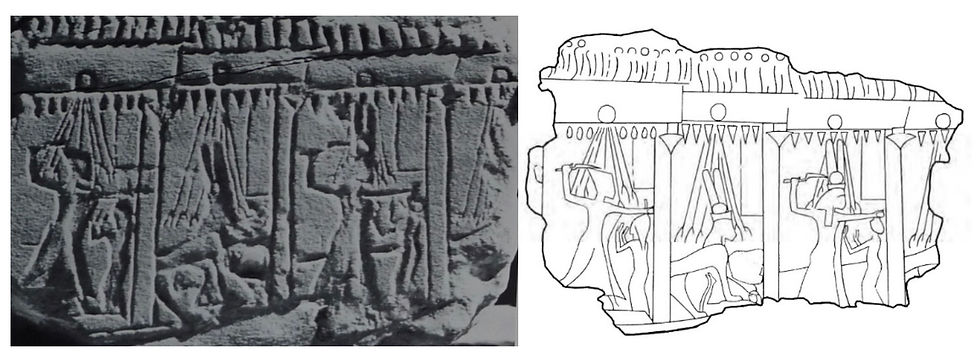
Often interpreted as an artist’s model so Nefertiti herself did not have to be physically present for her figure to be replicated within Amarna’s multiple temples and tombs, one of her finest images was created in the tomb of royal scribe and steward Apy (above). And although much of the tomb’s original detail has been destroyed over the last century (short clip at https://www.instagram.com/p/DXBvr8wDMIB/), its scenes were fortunately copied by the Egypt Exploration Society in 1906, mostly by their artist Norman de Garis Davies but Nefertiti’s image by the aforementioned Harold Jones, thereby providing yet another link between our queens and Barnsley. With her unmistakable figure wearing her trademark tall blue crown fronted by the ubiquitous cobra, she holds up an elaborate perfume vessel as an offering to the sun, her pleated robes of the same transparent linen represented on her red quartzite torso from Amarna displayed in the exhibition alongside an astonishingly fine section of royal linen c.1425 BC, discovered in the Valley of the Kings and kindly loaned by Bolton Museum (below).

As for the head beneath the tight-fitting crown, both the bust and wall scene clearly show the same gold brow band found around the shaven head of Tutankhamun’s mummified body and the similarly shaven-headed body of the previously anonymous royal woman we identified as Nefertiti back in 2003 (discussed at length in our book ‘The Search for Nefertiti’ (immortalegypt.co.uk/store). And with the impression of such a tight-fitting brow-band clearly visible in the light layer of embalming resins covering her shaven head, this display case therefore features the equipment employed to maintain such a smooth scalp, from the bronze razors and tweezers used – and found - at Amarna to the type of fine-toothed wooden comb used by those who chose to retain their own hair, or indeed to style the wigs preferred by others, like that found in the tomb of wealthy housewife Merit (https://intarch.ac.uk/journal/issue42/6/4.cfm).

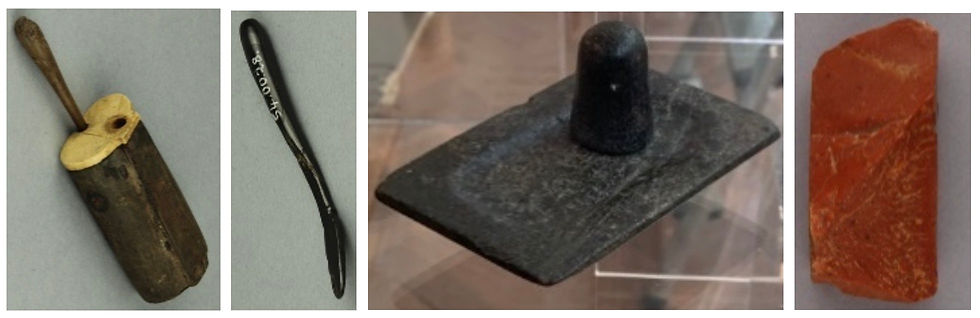
Likewise the display of cosmetics and perfumes employed during the Amarna Period. As an evolution of beauty products continuing from the previous two cases with the green malachite popular in the Pyramid Age and the Middle Kingdom’s black galena in small anhydrite pots, this third case features their development into the more familiar kohl tubes with practical swivelling lids and long applicator sticks. And with a delicate applicator of black haematite fashioned into a human hand with which cosmetics could be mixed, the grey slate cosmetic palettes of earlier times are contrasted with a more practical rectangular palette on which mineral pigments were now crushed up for use, be they black galena kohl or the various red substances used as both the blusher and lip colour highlighted so well by Nefertiti’s exquisite bust.
As for the all-important perfumes worn by all our royal women, from the lotus fragrance inhaled by Queen Hetepheres to the myrrh so loved by Hatshepsut, the elite ladies of Amarna were certainly well supplied too, with Pistacia resin imported from the Levant along with olive oil imported from the Greek world both found at Amarna. With the resulting perfumed oils now stored in exquisite containers, versions of the elaborate gold example held up by Nefertiti and captured in such detail by Jones’ drawing were found in the tomb of Tutankhamun (which of course contained so many objects from his Amarna predecessors). And of course there were the perfume vessels manufactured in newly-invented glass, the characteristic Amarna blue glass produced in the city’s glass factories with their swirling lines of yellow and white. So often discovered as fragments, the exhibition features a a superb replica made in the mid-C.19th by legendary Italian glassmakers Murano and kindly loaned by our friends at St. Helens World of Glass Museum.

Amarna also benefitted from its proximity to the quarries of Hatnub, the source of the creamy white alabaster used in architecture, sculpture and so often to make the vessels in which to store oil-based perfumes and cosmetics, whose inscriptions can often prove hugely informative. Take for example the large alabaster replica jar featured in last month’s blog (https://www.immortalegypt.co.uk/post/the-beauty-the-beast-hatshepsut-s-grandmother). Carved with the names and titles of female pharaoh Hatshepsut alongside reference to ‘24½ hin capacity’ (around 3 gallons) so quite possibly referring to the myrrh oil she used to reinforce her image as the gleaming ‘female sun’, its inscription is even more informative since all references to the state god Amun have been completely erased. Not only direct evidence for the censorship of his name by Akhenaten and Nefertiti, the fact that the vessel was actually found in their new royal capital Amarna highlights the fact that Nefertiti had to be aware of her illustrious predecessor, yet another female pharaoh continuing that same pattern of female influence stretching back literally to the very beginnings of Egypt’s written history with the name of Neithhotep herself.

Nor is this the only alabaster vessel in the exhibition to have been found at Amarna naming one of our 12 key queens. For our third royal woman in this trio is another wife of Akhenaten, Queen Kiya, a far more shadowy character than Nefertiti yet nonetheless referred to as Akhenaten’s ‘greatly beloved’ wife in the few surviving inscriptions. This includes part of a finely carved alabaster cosmetic vessel originally naming Kiya as his ‘wife and greatly beloved’, found in the State Apartments of Amarna’s Great Palace by the EES between 1934-1936 and presented to Bolton Museum.
And despite the many theories, Kiya remains the most likely mother of Akhenaten’s son Tutankhamun and possibly further offspring. We do know that her mother-in-law Tiye produced at least 6 children, 4 of them daughters, and Nefertiti was again the mother of 6 girls. So it did seem fitting to acknowledge the vital role of royal mothers by including amulets of the god Bes, protector of women and children whose image was routinely worn by women in labour either around the neck or even tied around the head, a practice which certainly continued at Amarna where all the amulets in our display originated (below).

One of these amulets makes up part of a bead necklace alongside a large carnelian Eye of Horus ‘wedjat’ amulet, both designed to ensure good health and safe delivery sometimes helped along it seems with drugs. So we’ve also included a pottery vessel made in the shape of twin poppy heads, a distinctive ‘bilbil’ form made on Cyprus from which opium was exported, not only as an ancient painkiller but added to wine for its relaxing effect and, as prescribed in medical texts c.1450 BC, to treat colic in babies: "capsules of poppy and fly dirt are mixed, strained and taken for 4 days; the infant stops crying immediately prescribed to treat colic in babies”. As a most useful recommendation within an ever-expanding royal nursery, it is quite possible that the ‘beloved’ Queen Kiya may herself have died giving birth to Tutankhamen if the damaged scenes in Amarna’s Royal Tomb do indeed represent this (as first suggested by the late Geoffrey Martin, continuing the work of Davies and Jones at Amarna when publishing these same scenes for the Egypt Exploration Society in 1989).
There are certainly very few known images of Kiya, the few examples featuring the short fringed ‘Nubian’ style wig as also worn by Nefertiti and occasionally Tiye, although Kiya almost always pairs this style with large round earrings, an example in the Metropolitan Museum once part of a larger scene in which she offers up sacrificial ducks to the sun disc opposite her aforementioned husband Akhenaten (Akhenaten Sacrificing a Duck - New Kingdom, Amarna Period - The Metropolitan Museum of Art).

And with this same image of Kiya featured in our Queens Timeline, her sculpted head in the display case again wears this so-called ‘Nubian wig’, the hole above her brow once set with a protective cobra. As one of 4 limestone canopic jar stoppers accompanying her inlaid coffin (with the same hairstyle) later amended for Akhenaten himself, all were discovered in the same Valley of the Kings’ tomb as the gilded shrine featuring Queen Tiye, as studied and drawn by the aforementioned Harold Jones to give each of our iconic Amarna trio a direct link to this Barnsley-born Egyptologist.
Jo and Stephen will be appearing as part of the ‘Churchyard Secrets Shared’ Festival at Washburn Heritage Centre on 4th July (details at https://www.facebook.com/WashburnHeritageCentre/), with Jo speaking on 25th July at Horus Egyptology Society in Wigan horusegyptology.co.uk/ and the Barnsley icons print by David Grant available at: https://davidgrantart.com/products/barnsley-icons-poster


Comments