


THE BEAUTY, THE BEAST & HATSHEPSUT’S GRANDMOTHER

Despite the fairy-tale like title of this month’s blog, the contents are pure ancient Egypt as we unpack the second display in our ‘Cleopatra & the Queens’ exhibition. And with its contents linking back to the Pyramid Age (in last month’s blog https://www.immortalegypt.co.uk/post/the-goddess-of-creation-history-s-first-queens-the-power-of-regalia), they also look forward almost 2,000 years when influencing Cleopatra herself.

With this case presided over by Hathor, goddess of beauty, love and motherhood, she often took cow form to express her benign and nurturing aspect. So her tall crown features a pair of cow horns, between which rests a sun disc to reflect her status as daughter and protector of the sun god whose shining brilliance was shared by Hathor as ‘the Golden One’. And as the deity who gave (re)birth to the dead, this light emerging from the darkness was expressed by that classic black and gold combo we’ve used throughout the exhibition space, as captured so brilliantly in the (admittedly OTT) outfits designed for Liz Taylor as Cleopatra (above). It’s also neatly expressed with some of our favourite objects from Bolton’s worldclass collection: a bronze crown most likely from a goddess figurine c.600 BC found at Abydos by the Egypt Exploration Society, displayed directly behind a gold amulet of Hathor in full bovine form, dated c.1000-700 BC and again found at Abydos by the EES (both below left).

Certainly such gleaming objects reinforce Hathor’s solar status as the so-called ‘Eye of Ra’, the sun’s ultimate protector embodied both by Hathor herself and fellow goddesses Sekhmet, Bastet, Rattawy, Mut, Tefnut and of course Wadjet the cobra, whose sinuous form sometimes extends directly out of the sun itself (above right at https://collezioni.museoegizio.it/en-GB/material/S_12363). And with Wadjet able to express the same firepower when poised protectively at the brow of Egypt’s monarchs, it’s also highlighted with our copy of a black granite goddess head whose cobra is gilded to further highlight its purpose (original at https://www.britishmuseum.org/collection/object/Y_EA956?selectedImageId=1613686694).

This same animal imagery also extends to the first in our trio of royal women within our second case, the so-called ‘Crocodile Queen’ Sobeknefru (c.1799-1795 BC). As Egypt’s first undisputed female pharaoh despite several earlier candidates including Merneith (https://www.immortalegypt.co.uk/post/the-goddess-of-creation-history-s-first-queens-the-power-of-regalia) and Khentkawes I (http://www.historyextra.com/article/premium/female-kings-ancient-Egypt), Sobeknefru - translating as ‘beauties of Sobek’ - was also the first Egyptian ruler to be named after Sobek, the crocodile god symbolising royal might.

With the god often partnered with Hathor especially during the Middle Kingdom, the monuments created at that time by Sobeknefru and her father Amenemhat III at his burial site Hawara included numerous statues of both Sobek and Hathor (above). So this same ‘beauty and beast’ theme extends to way we placed our aforementioned goddess head directly beside an actual crocodile. Admittedly a small one, given the case dimensions, its mummified form on loan from Bolton was similarly discovered at Hawara, with the crocodile of course a creature synonymous with Egypt by the time of Cleopatra herself.
And this same duality can be found in Sobeknefru’s own appearance. Sometimes portrayed in female dress paired with the typical bouffant hairstyle associated with Hathor, elsewhere she wears the same kingly regalia as her father and indeed all other pharaohs, from the kilt with tie-on bull’s tail to the false beard previously worn by the aforementioned Khentkawes I, even blending the pharaonic nemes headcloth with queenly costume. And with the traditional pharaonic title ‘son of Ra’ now feminised to ‘daughter of Ra’, Sobeknefru was also tapping into that solar power shared with Egypt’s key goddesses.

Sobeknefru was certainly an innovative and significant ruler. Appearing on official king lists for centuries after her death despite her omission from many modern histories of Egypt where, if mentioned at all, is usually dismissed as the last resort of an otherwise male dynasty, the throne nonetheless passed smoothly to a succession of male kings who followed her lead by naming themselves after the crocodile god.
And clearly her innovations also inspired the next female pharaoh Hatshepsut (c.1473-1458 BC) who adopted the same feminised kingly titles to become ‘Lady of the Two Lands’, ‘Perfect Goddess’ and ‘Daughter of the Sun God’. And again combining this with standard kingly regalia, including the much-discussed false beard, the modern tendency to cast Hatshepsut as some cross-dressing anomaly is only possible because her female forerunners are routinely played down when not ignored altogether.
But not in this exhibition!

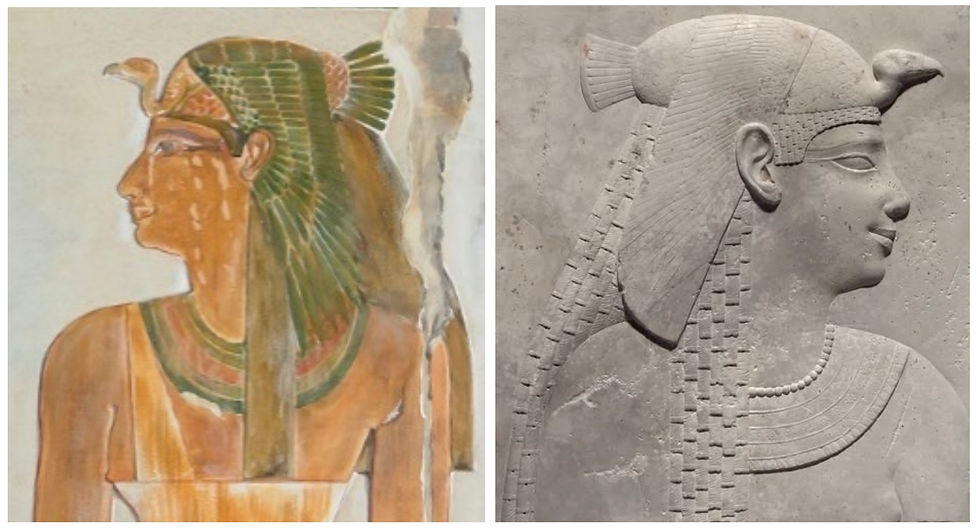
We’ve even been able to parallel Sobeknefru’s father-daughter relationship with that of Hatshepsut and her own father Tuthmosis I, appearing in our exhibition courtesy of the Egypt Exploration Society who’ve kindly loaned us their huge watercolour of a key scene from Hatshepsut’s temple at Hathor’s sacred site Deir el-Bahari (above). Painted there by none other than Howard Carter in 1894, some 28 years before he discovered the tomb of Tutankhamen, Carter’s work for the society as both archaeologist and artist not only captured coloured images then impossible to replicate by camera but preserves parts of this same scene since lost.
But its real power, for me at least, is the way the king is accompanied by his mother Queen Senseneb, maternal grandmother of Hatshepsut and a key figure in this illustrious family tree. And with this chunk of Deir el-Bahri magic now in Barnsley, visitors can get close enough to spot tiny pinholes revealing the way Carter constructed his masterpiece from smaller sections of paper, and of course to take in the beauty of Senseneb’s queenly regalia.

From her ubiquitous broad collar necklace to the beaded bracelets also featured in the displays, a particularly fine pearlized example is made from small sections of shell (above). Senseneb also wears the queenly vulture crown of course, in which the body of the vulture goddess Nekhbet, sister to Wadjet the cobra, embraces the royal head with her protective wings. And with the ancient Egyptian word ‘mut’ meaning both vulture and mother based on this same protective/embracing pose adopted by vultures when caring for their chicks, this distinctive vulture crown first worn by the aforementioned Khentkawes I c.2500 BC was still a divine symbol of protective motherhood, as worn by Cleopatra some two and half thousand years later.
And with Senseneb’s presence as Hatshepsut’s grandmother adding another layer of family relationships to an exhibition focused on Egypt’s women, the way each generation inspired the next very much recalls a chat we had during our ‘Egypt’s Lost Queens’ documentary with the celebrated writer Sahar el-Mougy. As she told us herself, “I grew up not knowing about those women except in boring history books in school, (but) in the process of writing I was getting to know my mothers and grandmothers. And that’s why in my writing, those female goddesses come back to life as inspiring figures. The amount of power that I received from knowing about them, through my own eyes, was immense. It was magical. It was like ‘wow’, this is where I come from!” (28 minutes into ‘Egypt’s Lost Queens’ at https://www.facebook.com/watch/?v=609435185885875).
And certainly of all Egypt’s inspirational female figures, Hatshepsut is one of the greatest, surviving both ancient and modern attempts to erase her from the historical record to live up to her own words “I shall be eternal like an undying star”, a quote we use within the exhibition.
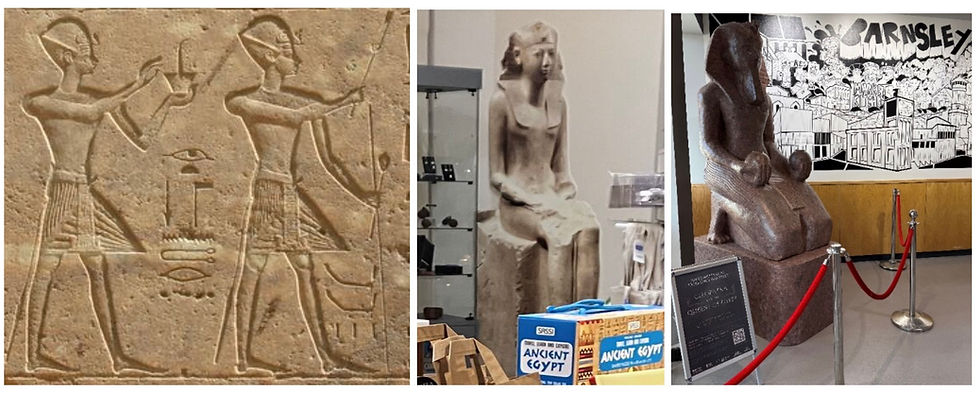
As daughter of the aforementioned Tuthmosis I, Hatshepsut had been married to her half-brother Tuthmosis II to strengthen his claim to the throne and the couple had a daughter Neferure. And although at his death Tuthmosis II also left a son by a minor wife, he was still very young so Hatshepsut took power as pharaoh until this son came of age and they co-ruled together. And with these two co-rulers portrayed in identical royal regalia (below left), Hatshepsut in kingly garb appears throughout the exhibition space and beyond, with her life-size image presiding over the museum’s shop and a colossal granite statue replica currently in residence in Barnsley’s new Glassworks shopping centre advertising the exhibition a short distance away (below).
During her reign building numerous temples throughout Egypt and Nubia, Hatshepsut’s trade with the Minoans maintained links stretching back to the Pyramid Age (as highlighted in the first display case via Greek silver bracelets at: https://www.immortalegypt.co.uk/post/the-goddess-of-creation-history-s-first-queens-the-power-of-regalia). And with surviving accounts referring to her military expeditions against Nubia, more scenes in her Deir el-Bahri temple portray her as a smiling lion-bodied sphinx trampling enemies underfoot (below), warning that “I am ‘She who will be a Conqueror’, flaming against my enemies! My command is as enduring as the mountains, and the sun disc spreads its rays over my names forever and ever”.

Yet most famously of all, Hatshepsut is known for her international trade with ‘Punt’. As a region located at the southern end of the Red Sea encompassing both Eritrea and Yemen which we toured back in 2002, both produce the myrrh resin Hatshepsut required for use as incense in daily temple rites and as her ‘signature fragrance’. Described as ‘divine dew’ made from the ‘best myrrh’ crushed and mixed with oil to anoint her skin, as recreated in our study days’ practical sessions, the exhibition features a bowl of this same resin alongside another special loan from the EES: a replica of a large alabaster jar they discovered in 1923, carved with Hatshepsut’s royal names and titles alongside reference to ‘24½ hin capacity’ so around 3 gallons.

All accompanied by an array of smaller alabaster jars which still retain clear traces of their original perfumes, Hatshepsut’s lavish use of myrrh oil allowed “her skin to shine as stars” while reinforcing her image as the self-styled ‘female sun’. And with her gleaming appearance connecting her directly with Egypt’s supreme solar deity and a plethora of protective goddesses, she in turn inspired the next generation of royal women we’ll meet next month - unless of course you visit the exhibition before then…
Jo will be appearing at the 129th birthday celebrations for Sheffield’s Cat Shelter on 30th May with details at: https://thesheffieldcatsshelter.org/2026/our-129-birthday-party; also at the next Bolton study day ‘Animals in Egyptian Religion’ on 6 June with details at: https://www.eventbrite.co.uk/e/boltons-egypt-spring-study-day-animals-in-ancient-egyptian-religion-tickets-1984866401839; she is also speaking at Bolton Archaeology & Egyptology Society on 17th June https://www.boltonaes.co.uk/current-programme/; on 19th June she’s hosting the Egypt Exploration Society event ‘A Night with Amelia Edwards in Bolton’ https://www.ees.ac.uk/whats-on/events/a-night-with-amelia-edwards-in-bolton.html and on 27th June is speaking as part of the ‘Agatha Christie Day’ at Bolton Library https://www.eventbrite.co.uk/e/agatha-christie-day-tickets-1988920228945


Comments