


THE ARRIVAL OF THE QUEENS OF EGYPT
Updated: Apr 6

Wow, what an amazing month, during which the Queens of Egypt finally arrived in Barnsley!
Meeting their public for the first time on 7th March, International Women’s Day, Cleopatra herself now takes centre-stage via her marble bust, the original housed in Berlin’s Staatliche Museen replicated for us by the museum’s renowned Gipsformerei Workshop (below).
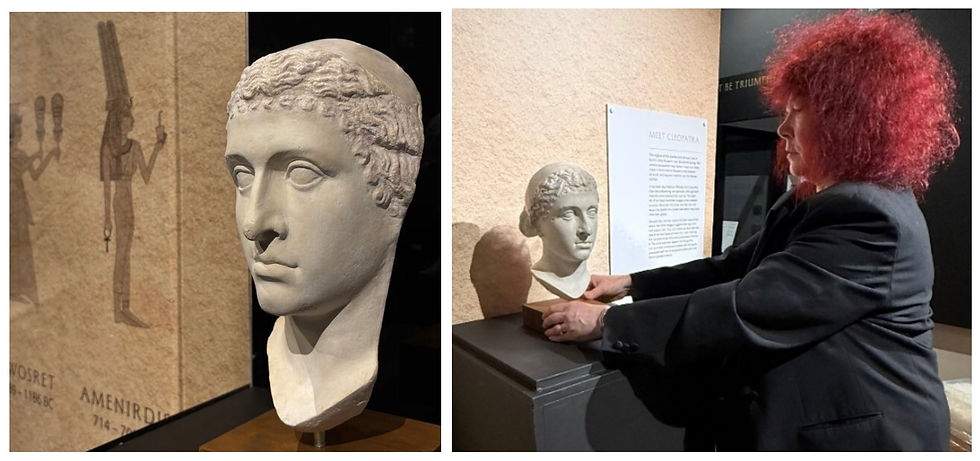
After more than three years’ planning with our colleagues at Barnsley Museums led by the wonderful Natalie Murray, we’ve also worked closely with the Egypt Exploration Society (EES) and with Bolton Museum’s curator Ian Trumble (whose original predecessor William Midgley came from a Barnsley-based family). And having secured some spectacular loans from the British Museum, we’ve also been privileged to borrow outstanding pieces from the EES archives, including one of the few known depictions of C.16th BC Queen Senseneb in the form of a huge watercolour (below, and see: https://www.ees.ac.uk/resource/howard-carter-from-tracer-to-tutankhamun.html).
Painted by none other than Howard Carter when working for the society in 1894 some 28 years before he discovered the tomb of Tutankhamun, the image replicates exactly a scene in the Deir el-Bahri funerary temple of Senseneb’s famous granddaughter, female pharaoh Hatshepsut, who of course features in the exhibition too, in the museum gift shop and even in Barnsley’s new shopping centre…

And with over 100 ancient artefacts in the exhibition acquired during EES excavations at sites throughout Egypt and presented to Bolton’s world-class collection, these include objects discovered at the royal tombs site at Abydos, gold amulets and amethyst jewellery, rare wine vessels and papyri documenting aspects of lives lived at the time of Cleopatra.
There are also coins from Scarborough’s superb numismatic collection featuring Cleopatra’s Macedonian and Ptolemaic ancestors, her partner Julius Caesar and nemesis Octavian, objects from ancient Alexandria acquired by Wigan-born Sir John Scott loaned by our fantastic colleagues at Wigan Museum, and a delicate blue glass replica perfume vessel from our friends at St. Helen’s World of Glass, perfectly complementing Roman glassware from Barnsley’s own collection alongside a wonderful ancient dining scene in white marble.

Ending with our largest case, we selected fascinating gems from the extensive collections of the Egyptomania Museum (above) to showcase how the modern world looks back at Cleopatra in much the same way she looked back at three millennia of the royal women before her, their figures forming our ‘Timeline of Queens’ located in the centre of the exhibition space.

As something we designed in the manner of an ancient temple wall ‘king list’, this chronological progression of female power supports what we say in our introduction: “this exhibition covers 5,000 years, beginning with the first named woman in history and ending with its most famous. From Neith-hotep to Cleopatra VII, both were queens of Egypt whose legacies are still celebrated today”.
We also highlight that while most of Egypt’s female rulers held the title queen, or more correctly ‘royal wife’, some were certainly pharaohs too, as supported by their titles and regalia and explaining the emphasis on both literacy and adornment throughout our exhibition themes.
And much like their male counterparts, these female rulers undertook monumental building work, mining expeditions and international trade, in some cases even leading armies with weaponry also highlighted by the mix of objects on display. For along with the mace heads found in male and female burials and a range of arrowheads acknowledging the firepower of goddess Neith, Nefertiti’s famous bust, again replicated by Berlin Museum’s renowned Gipsformerei Workshop, is displayed with images of her actively terminating enemies when defending her country.
For most of these royal women, as mothers and indeed grandmothers, were able to combine nurturing with protection in the same way as Egypt’s key goddesses whom they chose to embody via their aforementioned titles and regalia. So beginning with the warlike Neith, the creator deity who gave birth to the sun, we then feature Hathor the gentle cow goddess (below left) and her alter-ego Sekhmet the lioness, goddesses Mut and mighty Isis (below centre), and of course Wadjet the cobra. As the heraldic deity of the North (below right), Wadjet’s sinuous form was placed on the front of royal crowns to provide divine protection, her image throughout the exhibition also forming our main design using that classic Egyptian colour scheme black and gold.
Drawing down the powers of the gleaming sun with the ancient Egyptian colour of life based on the rich Nile silt bringing life to Egypt’s otherwise desert environment, it also links directly to Isis ‘the black-robed queen’ as personified by her chief devotee, Cleopatra herself (see: https://www.immortalegypt.co.uk/post/hidden-histories-of-the-hair-pin-starring-cleopatra-the-wearers-of-black).

And having worked closely with Barnsley Council to advertise the exhibition across town and beyond, FrontRowLive and the Yorkshire Post have provided wonderful coverage too, as has one of Hatshepsut’s colossal statues. Recreated as part of a recent exhibition in Bolton and now brought over the Pennines to take her place at the heart of Barnsley’s new shopping centre The Glassworks (below left), here she informs shoppers they’re only 10 minutes’ walk from the exhibition within Barnsley’s fine town hall, complete with appropriately black and gold banners (below right).

Such early publicity meant we were able to welcome over 500 visitors on our opening day, some having queued to get in and travelling from as far afield as Portsmouth, London and even Barcelona. And with the exhibition’s generous 12 month run allowing us to focus on key themes over the coming year’s blogs to really get into the detail of the artefacts themselves, we’ll not only be revealing lesser-known details about Egypt’s remarkable female leaders but some surprising connections to history on a far more local level.
For as revealed over the last 40 years of our self-funded ‘Egypt in Yorkshire’ project, we have the amazing silver coins minted by Cleopatra and Mark Antony discovered at Darfield, and alongside the antiquarian activities of the Spencer Stanhope family of Barnsley’s Cannon Hall, the exhibition also includes work by Barnsley-born artist-turned-archaeologist Harold Jones who played a key role in the search for the tomb of Tutankhamun.
And Jones’ work in the Valley of the Kings also provides some of the exhibition’s key images: the spectacular jewellery discovered in the so-called ‘Gold Tomb’ KV.56 portraying female pharaoh Tawosret, the figure of Queen Tiye on the golden shrine from tomb KV.55 which he drew so skilfully before it crumbled away to virtually nothing, and his image of Nefertiti created during his time at Amarna, working with EES’ artist Norman de Garis Davis. Yet for me his most accomplished image portrays goddess Isis in her iconic throne crown guarding the symbol of eternity, created while he was documenting scenes within tomb KV.47 in 1907 (below left).

And of course with Jones a colleague of Howard Carter whose aforementioned watercolour of Queen Senseneb is displayed close by on loan from the EES, their director Dr. Carl Graves came north to Barnsley to officially open the exhibition in a most appropriate Cleopatra t-shirt – black, of course (above right). Then with an extra special mention of Ian Trumble whose contributions have been truly immense, plus support from our trio of modern-day queens Lydia, Jackie and Penelope, celebratory toasts were raised to the numerous people who’ve made the exhibition possible, all of whom will appear in forthcoming blogs alongside the wonderful things their generosity brought together in Barnsley – thank you all so, so much!
News of exhibition events over the next 12 months will be appearing at https://www.barnsley-museums.com/whats-on/cleopatra-and-the-queens-of-egypt-exhibition and on Immortal Egypt’s social media sites. Jo and Stephen are also appearing on 16th May as part of the ‘Peopling the Past’ event for Scarborough’s Big Ideas by the Sea with details at: https://www.ticketsource.co.uk/bibts/peopling-the-past-what-can-we-learn-from-the-dead/e-kqdpeq Jo is also speaking in Bolton as part of their otherwise sold-out April study day, details at: https://www.eventbrite.co.uk/e/animals-in-ancient-egyptian-religion-tickets-1985041583813, with a Stephen and Jo double act part of the full study day repeated in June for which some tickets are still available at: https://www.eventbrite.co.uk/e/boltons-egypt-spring-study-day-animals-in-ancient-egyptian-religion-tickets-1984866401839


nice text bro
How exciting! In awe and I LOVE The Timeline of Queens!