


Literary Queens of Style: from Nefertari to Agatha Christie

With our current exhibition ‘Cleopatra and the Queens of Egypt’ continuing to dominate much of our day-to-day work, we’ve reached July, the month named after Cleopatra’s partner Julius Caesar. Not that we’re obsessed with the great woman and her female predecessors (much!), but work over the last few weeks has included a Cleopatra-themed tv project, writing an introduction for a new exhibition in Dublin (highlighting the hair of Egypt’s royal women) and giving a Bolton Library talk about the ‘Queen of Crime’ Agatha Christie (above) whose own links to Egypt range from her play about queens Nefertiti and Tiye to playing bridge with Howard Carter.
Then as part of the current Festival of Archaeology organised by the Council for British Archaeology, we’re also writing daily posts for Barnsley Museums to share some of our favourite exhibition objects on Facebook and Instagram. And we began, of course, with that “tangible, physical connection between Barnsley and Cleopatra herself”, the silver coins minted by Cleopatra and second husband Mark Antony and discovered in Barnsley’s Darfield in the 1940s and featured in this short film: CleoReel JF DarfieldCoins v1 1 - YouTube

Then working chronologically through the exhibition, our daily choices feature objects relating to the great women of ancient Egypt plus those involved in the objects’ discovery - and in their preservation. For archaeology extends far beyond ‘finding things’, and requires conservators, scientists, curators, archaeological artists and photographers, much like Agatha Christie herself. For not only is she the best-selling novelist of all time, she also worked quietly in the background as her archaeologist husband’s right-hand woman (below): typing up his work, photographing his finds and even conserving certain pieces using supplies of her own moisturising cream, some of these very things now part of Bolton’s world class collection and currently in their ‘Unpacked: From the stores’ exhibition (1) Instagram

And it’s this same diverse mix of archaeology, conservation, science, art and photography reflected in our 4th exhibition display case highlighting a queen, princess and female pharaoh each directly connected with the great mother goddess Mut of Thebes. With her golden image extending her hand to the top of our display case (below left), Mut’s name means both ‘mother’ and ‘vulture’, based on the way female vultures protectively surround their chicks with their extended wings in a practice known as ‘mantling’. And not only did the Egyptians replicate this powerful gesture in jewellery, so too with the vulture crown which literally embraces the head of the royal women who wore it along with goddess Mut (below left & centre).

The goddess’ vulture headgear was often topped with the double crown of a united Egypt to symbolise dominion over both halves of the country, although this was sometimes worn alone, as seen on her steatite figurine carved c.1300 BC. Discovered at North Sakkara by the Egypt Exploration Society (EES) during the 1960s, the figurine was presented to Bolton Museum who’ve kindly loaned it to us (above right).

And our first queen in the case Mut protects is Nefertari (c.1279-1255 BC). As one of the two main wives of Ramses II and mother of at least 6 of his one hundred plus children, the name Nefertari means ‘the most beautiful’, a reputation she no doubt preserved with the type of face cream (Agatha would be proud!) discovered inside a small ivory and rosewood pot bearing her name Nefertari ‘Meritmut’, ‘beloved by goddess Mut’ (above right). And certainly beloved by her husband, whose claim Nefertari was “the one for whom the sun itself does shine” was inscribed on her beautiful temple at Abu Simbel. As a site featured in Agatha’s most famous novel ‘Death on the Nile’, we filmed Nefertari’s temple for ‘Egypt’s Lost Queens’ with the Director General of Antiquities in Aswan, the wonderful Ahmed Saleh (33 minutes into Egypt's Lost Queens (BBC) - YouTube) and now we visit every year.
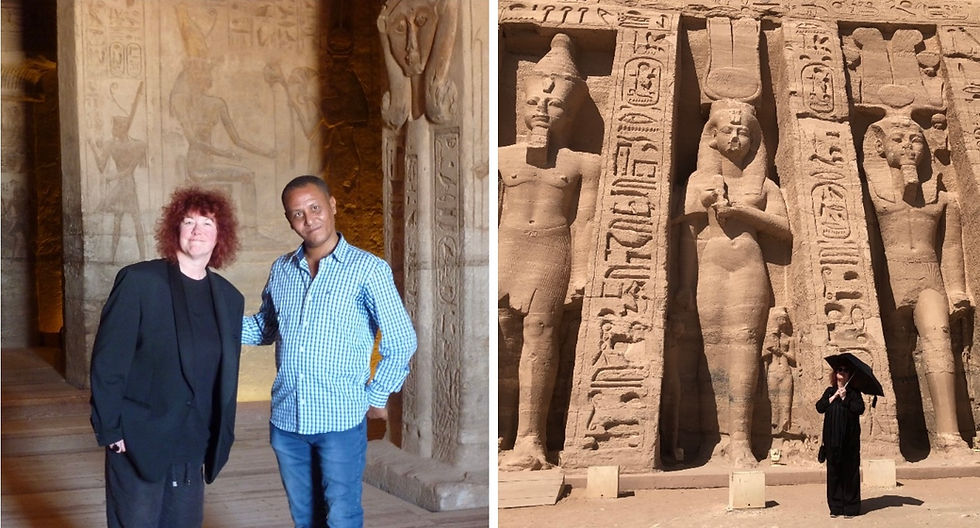
Having always been struck by the fact Nefertari’s husband appears twice as often as she does on the façade of a temple dedicated to her, equally intriguing is the fact that as a man for whom size was apparently everything he did allow her to appear that tiny bit taller than him, at least at this temple (above right) – presumably linked to the fact that Nefertari here is channelling divine powers through her tall crown of twin feathers and sun disc.
And since the original bright colours of Ramses’ companion temple at Abu Simbel had been recently recreated to great effect by our colleague archaeologist Guy de la Bédoyère at: https://www.youtube.com/watch?v=M3Hun2liTzE&feature=youtu.be, we asked if he could work the same magic if we sent him our photos of Nefertari’s equally sun-bleached temple, which he kindly did for us.


Of course, hidden away from the sunlight in the depths of the Theban hills, the vivid colours on the walls of Nefertari’s tomb are among the finest to have survived (watch at: BBC Two - Egypt's Lost Queens, The tomb of Nefertari). Rediscovered by Italian archaeologists in 1904, the tomb’s wall scenes were conserved by experts from the Getty Foundation between 1986-1992 (see the 1989 BBC ‘Chronicle’ film at https://www.youtube.com/watch?v=KoMqbVsDZSo), their work even uncovering a fragment of one of the queen’s gold bracelets embossed with her name (below left).

Presumably dropped by the same ancient looters who’d also ripped apart her mummified body leaving only sections of legs we ourselves studied with international colleagues back in 2016 (Queen Nefertari, the Royal Spouse of Pharaoh Ramses II: A Multidisciplinary Investigation of the Mummified Remains Found in Her Tomb (QV66) | PLOS One), our study also describes more of the objects left behind by the ancient looters: “a damaged pink granite sarcophagus, broken furniture, jars, shabtis, other various small items, a pair of sandals” and a blue faience handle of a casket naming the earlier pharaoh King Ay, successor of Tutankhamen (all below).

Raising the real possibility that Nefertari may have been descended from a minor branch of the previous 18th dynasty, this tantalising royal heirloom yet again emphasises that the tiniest objects can often tell the biggest stories, something we’ve been keen to highlight in the Barnsley exhibition. And by zooming in on Nefertari’s regalia, we’ve often pointed out that “there’s rather more to this jewellery and frocks business than at first meets the eye….” (44 minutes into Egypts Lost Queens).
So we show her in her tall crown of feathers and sun disc worn atop her crown formed by the vulture whose head alone protrudes protectively from the front, the all-important uraeus cobra usually featured in this prime position appearing instead in the innovative form of cobra earrings to double up on levels of divine protection (below left).
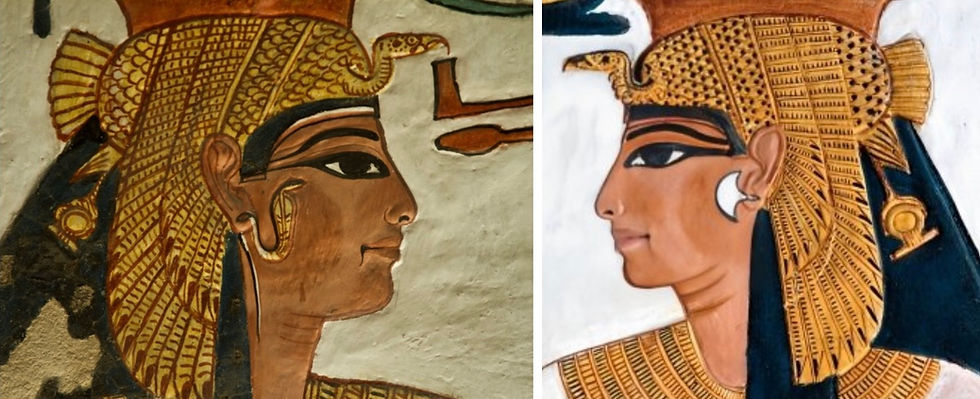
Yet perhaps the most fascinating detail in the tomb are Nefertari’s other choice of earrings (above right). Described as a ‘Creto-Mycenaean’ type known from the ancient Greek world, they were likely sent to Nefertari c.1279 BC as a diplomatic gift. Clearly made of non-native silver which really stands out amidst the usual sea of Egyptian gold, this continuity with Queen Hetepheres’ bracelets of Aegean silver made c.2600 BC over a thousand years before Nefertari (https://www.immortalegypt.co.uk/post/the-goddess-of-creation-history-s-first-queens-the-power-of-regalia) is yet more evidence Egypt and Greece were already in direct contact by the Pyramid Age, and that the mixed Greek-Egyptian heritage of Cleopatra herself was simply the culmination of cross-cultural contact stretching back over two and a half thousand years.
But things become even more intriguing when we then look at who exactly Nefertari is so dressed up to meet: not husband Ramses who is nowhere to be found in this most beautiful of tombs, but the very gods themselves, most significantly Thoth to whom she announces “Behold! I am a scribe” in a quote we feature over the display case (below right).

And with this powerful claim of female literacy supported by Nefertari’s own writing palette shown prominently in front of her (above left), the queen is also known to have written diplomatic correspondence to her opposite number the Queen of the Hittites. So an actual writing palette had to features in the display (above centre), this fine example made from ebony naming Thoth and his female colleague Seshat, goddess of writing and again on loan from the Bolton collection. So too a superb gold amulet of Thoth as an ibis suspended on blue beads (below left), plus a bright blue faience ring featuring the ubiquitous cartouche of Nefertari’s husband Ramses (below right).

His name is also writ large on the blue faience handle of a sistrum (sacred rattle), as played by wife Nefertari who was even sometimes shown with a sistrum in each hand (below left). As one of a queen’s ritual duties when honouring key deities including Mut and Hathor, both of whom could be represented by a cat as featured on the replica sistrum we have in the case too (below centre), the ancient sistrum handle was discovered at Hathor’s temple at Serabit el-Khadim. And so too a second such example, this one naming King Seti II to introduce his rather more famous wife Tawosret, the second royal woman in our display case.

With both Seti and wife Tawosret direct descendants of Ramses II, Tawosret’s name means ‘the Mighty One’ but, like Nefertari, also acknowledging the goddess in her additional title ‘Setepenmut’, ie. ‘chosen by goddess Mut’. And again like Nefertari shown playing two sistrums as ‘God’s Wife’ priestess in scenes at Amada Temple in Nubia (above right), Tawosret also appears as a queen when standing before her enthroned husband Seti, dutifully pouring his wine (below).

Now these wine-pouring scenes are fascinating on several levels, not least because once again they appear on royal bracelets in this case made of electrum, a combination of the gold and silver featured in Nefertari’s tomb but here the precious metals combined. Found in 1908 in the so-called ‘Gold Tomb’ (KV.56) in the Valley of the Kings along with necklaces, rings and enormous earrings, all of which were studied, painted and drawn by our old friend, Barnsley-born artists-turned-archaeologist Harold Jones soon after their discovery, and once again providing us with yet another local link in our progression of Egypt’s royal women.
Yet after Seti II’s death, Tawosret eventually succeeded him as pharaoh c.1189-1186 BC, the ancient records claim that she ruled Egypt “at the time Troy was taken” yet another cultural cross-over with the Greek world. And with a wonderful statue of her elevation to the throne previously known only from photographs, it was recently put on display in Cairo’s new Grand Egyptian Museum where we’ve been able to study it at first hand with our friends at The Cultural Experience (see: OUR EGYPTIAN ‘CULTURAL EXPERIENCE’). Dressed in a combination of finely pleated linen robes topped with the striped nemes headcloth of a king to evoke her predecessors Hatshepsut and Sobeknefru (below left), Tawosret certainly achieved full pharaonic status. With a royal funerary temple on Thebes’ West Bank alongside those of fellow pharaohs, her large tomb in the Valley of the Kings is another destination we’re always keen to visit on our trips to the valley.

Yet with this tomb and its contents soon usurped by a new dynasty, her male successor Sethnakht taking over her tomb and her pink granite sarcophagus re-used by Sethnakht’s grandson Prince Amunherkhepeshef (above right), their additional destruction of both her statues and her funerary temple was part of their targeted erasure of Tawosret’s legacy. In so many ways reflecting what had happened to previous female rulers Nefertiti and Hatshepsut – and indeed what would lay in store for Cleopatra herself – Tawosret was the final female pharaoh for the next 900 years, when women had to wield their power in other ways.
Usually as a queen (ie. royal wife) or princess, those raised to the rank of ‘God’s Wife’ high priestess in Thebes gained political control of all southern Egypt, even undergoing their own coronation and receiving a throne name in acknowledgement of their regal powers (see: https://isac.uchicago.edu/museum-exhibits/nubia/god%E2%80%99s-wives-amun). And this was certainly the case with our third royal woman Amenirdis (714-700 BC).
As part of the 25th ‘Kushite’ dynasty (c.770-657 BC) originating in Nubia (modern Sudan), their conquest of Egypt created a vast combined kingdom stretching from the confluence of the Nile (around modern Khartoum) to where it empties into the Mediterranean some 3,000km to the north. And Amenirdis was the most powerful woman of her time. For she was the daughter of King Kashta, sister of successive kings Shabaka and Piye and the aunt of the mighty King Taharqa whose achievements feature in our BBC series (10 minutes into https://www.youtube.com/watch?v=IhTWSTofwCM&list=PL2vJ5Cg-wlPxFdk_JcD5Xo0PZqj1I3nRd&index=6) including his fabulous temple at the dynastic capital Gebel Barkal.
Built to honour the gods Amun and of course his divine wife Mut, the temple’s sandstone walls featured images of the goddess in her distinctive Egyptian regalia but with a very special Nubian addition. As kindly revealed to us by Gebel Barkal expert archaeologist Dr. Tim Kendall, he brushed away the windblown sand to reveal the goddess’s face, bearing the same facial scarification as the women of the region, perhaps including Amenirdis herself.

And to further highlight Amenirdis’ direct link to Gebel Barkal and her nephew Taharqa, our Barnsley display features a copy of a large faience amulet from this very temple (above left). Made c.700 BC and combining the ankh symbol of life with the symbols for stability and dominion, it was bought by Lord Kitchener from the Egyptian antiquities’ dealer Muhammed Mohassib in 1919 and later acquired by the British Museum, who on the basis of its findspot, large size (24cm long) and lack of any means of suspension say that “it was probably made to be carried” (https://www.britishmuseum.org/collection/object/Y_EA54412), as indeed Amenirdis does in her role of God’s Wife high priestess (above right).
Holding both her ankh and mace as she grasps the powers of both life and death in her chapel scenes at Medinet Habu, one of her many cartouches from the site still retaining traces of the original red pigments is now part of Bolton’s world-class collection and currently on loan in Barnsley (below right).

And like her two royal companions in the same display case, Amenirdis was a devotee of the same goddess, as reflected in her throne name ‘Hatneferumut’, ‘the Beautiful Appearance of Mut’ and her additional title ‘Meritmut’, ‘loved by goddess Mut’. Like them she also wears the vulture crown topped by tall feathers and protective cobra, holds out fragrant incense (above left) and plays her sistrum in rituals which had continued down the centuries and would continue to do so, culminating, of course, with the great Cleopatra herself.
Jo will be speaking at the Horus Egyptology Society at the DW Stadium in Wigan on 30th July, her essay ‘Hairdressing in Ancient Egypt’ supporting Amanda Jane Graham’s new exhibition ‘Peer’ at Dublin’s LAB Gallery (8.7.26-15.8.26) featured at: https://www.dublincityartsoffice.ie/programmes-projects/lab-gallery/peer


Comments